← Back to Projects
Designing and simulating a 8-bit ALU
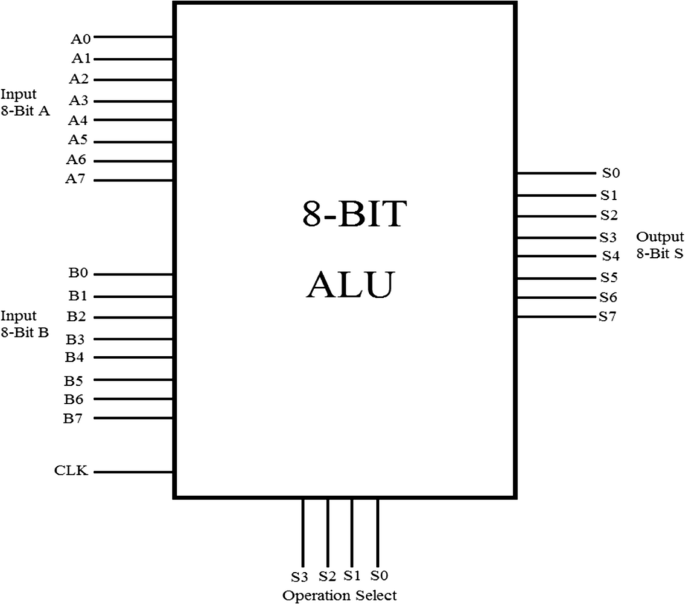
The ALU is implemented as a combinational logic circuit, where the output is directly determined
by the instantaneous state of the inputs.
● Inputs: The module accepts two 8-bit binary operands, A and B.
● Control Mechanism: An Opcode serves as the control signal, selecting the specific
operation to be performed.
● Operation Execution: A case statement is used to map the Opcode to the
corresponding operation, which includes common functions like addition, subtraction,
AND, OR, and other bitwise operations.
● Outputs: The result is provided as an 8-bit output. Additionally, flags such as Carry (to
indicate overflow) and potentially Zero (to indicate a zero result) are generated for
arithmetic operations.
● Verification: Since no physical hardware was used, a Verilog Testbench was created to
simulate the design and process the inputs. The functionality and correctness were
verified by analyzing the resulting digital waveforms in the timing diagrams.
by the instantaneous state of the inputs.
● Inputs: The module accepts two 8-bit binary operands, A and B.
● Control Mechanism: An Opcode serves as the control signal, selecting the specific
operation to be performed.
● Operation Execution: A case statement is used to map the Opcode to the
corresponding operation, which includes common functions like addition, subtraction,
AND, OR, and other bitwise operations.
● Outputs: The result is provided as an 8-bit output. Additionally, flags such as Carry (to
indicate overflow) and potentially Zero (to indicate a zero result) are generated for
arithmetic operations.
● Verification: Since no physical hardware was used, a Verilog Testbench was created to
simulate the design and process the inputs. The functionality and correctness were
verified by analyzing the resulting digital waveforms in the timing diagrams.
The core objective of this project was to design and functionally verify an 8-bit Arithmetic Logic Unit (ALU) using behavioral Verilog HDL. As a fundamental component of a Central Processing
Unit (CPU), the ALU is responsible for executing both arithmetic and logical operations.
Source Code
Files
Select a file
Loading...
Click folders to browse. Click a file to preview its code here.