Semicon DTU is a student-led technical society at Delhi Technological University,
focused on semiconductor technologies, VLSI design, embedded systems, and
research-oriented engineering. The society functions as a structured platform
for students to develop strong technical fundamentals, hands-on design skills,
and a research-driven mindset aligned with academic and industry expectations.
Background & Motivation
The rapid advancement of semiconductor-driven technologies has created a growing
demand for engineers with strong foundations in VLSI, system design, and research
methodologies. Traditional coursework often provides limited exposure to complete
design flows and real-world engineering practices. Semicon DTU was established to
bridge this gap by creating a focused, student-driven ecosystem that promotes
structured learning, experimentation, and innovation in semiconductor engineering.
Mission
The mission of Semicon DTU is to build strong fundamentals in semiconductor and
electronics engineering, promote a culture of research and technical documentation,
and prepare students for careers in core electronics industries, higher studies,
and academic or industrial research roles.
Vision
Semicon DTU envisions becoming a recognized and sustainable student technical
community that contributes meaningfully to the university's research ecosystem
while producing industry-ready engineers and research-oriented graduates in
semiconductor and electronics domains.
How We Work
The society follows a structured working model centered around mentorship,
project-based learning, and disciplined engineering practices. Members progress
through guided learning paths under senior and faculty mentorship, followed by
hands-on implementation, review, validation, and documentation. This approach
ensures continuity of knowledge, technical depth, and professional rigor.
Laboratory & Infrastructure
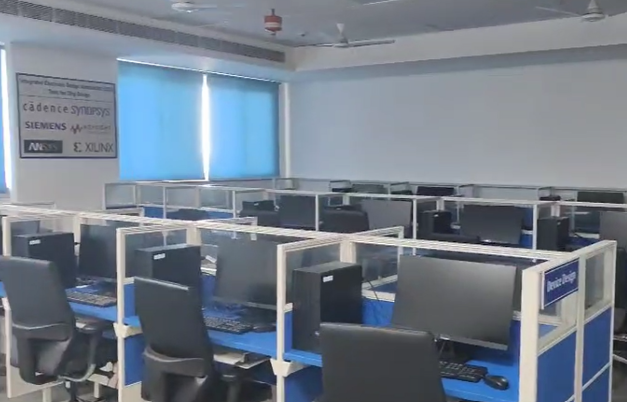
Semicon DTU is supported by dedicated laboratory infrastructure that enables
students to engage in design, simulation, and development activities related to
semiconductor and embedded systems. The lab serves as a collaborative workspace
for hands-on learning, experimentation, and project execution.
The laboratory is equipped with 15 desktop systems, each featuring
an Intel Core i7 (13th Generation) processor, 16 GB RAM,
and 1 TB storage. This computing capability supports resource-intensive
EDA tools, simulations, and development workflows required for modern semiconductor
engineering tasks.
Software & EDA Tools
Semicon DTU provides exposure to industry-standard Electronic Design Automation
(EDA) tools and development platforms used in semiconductor design and research.
These tools are utilized during workshops, training sessions, and project-based
learning activities to familiarize members with professional design workflows.
Key tools include FPGA and RTL development environments such as Vivado, analog and
mixed-signal design platforms like Cadence Virtuoso, and digital design and
verification tools from the Synopsys toolchain. Access to these tools helps bridge
the gap between academic learning and real-world engineering practices.
Institutional Association
Semicon DTU operates within the academic framework of Delhi Technological University
and is associated with the Vinod Dham Center for Research and Innovation.
This association aligns the society's activities with the university's broader
research and innovation objectives while supporting student-led technical initiatives.
Vinod Dham Center for Research and Innovation
The Vinod Dham Center for Research and Innovation at Delhi Technological University
was established to foster a strong culture of research, innovation, and
interdisciplinary collaboration. The center encourages hands-on research,
supports student-driven initiatives, and promotes the application of engineering
knowledge to real-world challenges.
Through its association with Semicon DTU, the center plays a key role in enabling
structured technical activities, research-oriented learning, and innovation-driven
student engagement within the university.
Academic Integrity & Professional Ethics
Semicon DTU places strong emphasis on academic integrity, ethical engineering
practices, and responsible research conduct. Members are encouraged to maintain
professional standards, avoid plagiarism, respect intellectual property, and
uphold ethical values in all technical and academic activities.
Semicon DTU | Semiconductor & Microelectronics Society